Culture / Ancient Cities
Simena, the Small Lycian Town Without a Road
A Lycian coastal town that shared a single vote with three neighbours, now a roadless village under a medieval castle, with a theatre cut into the rock and a Roman bath partly under the sea.

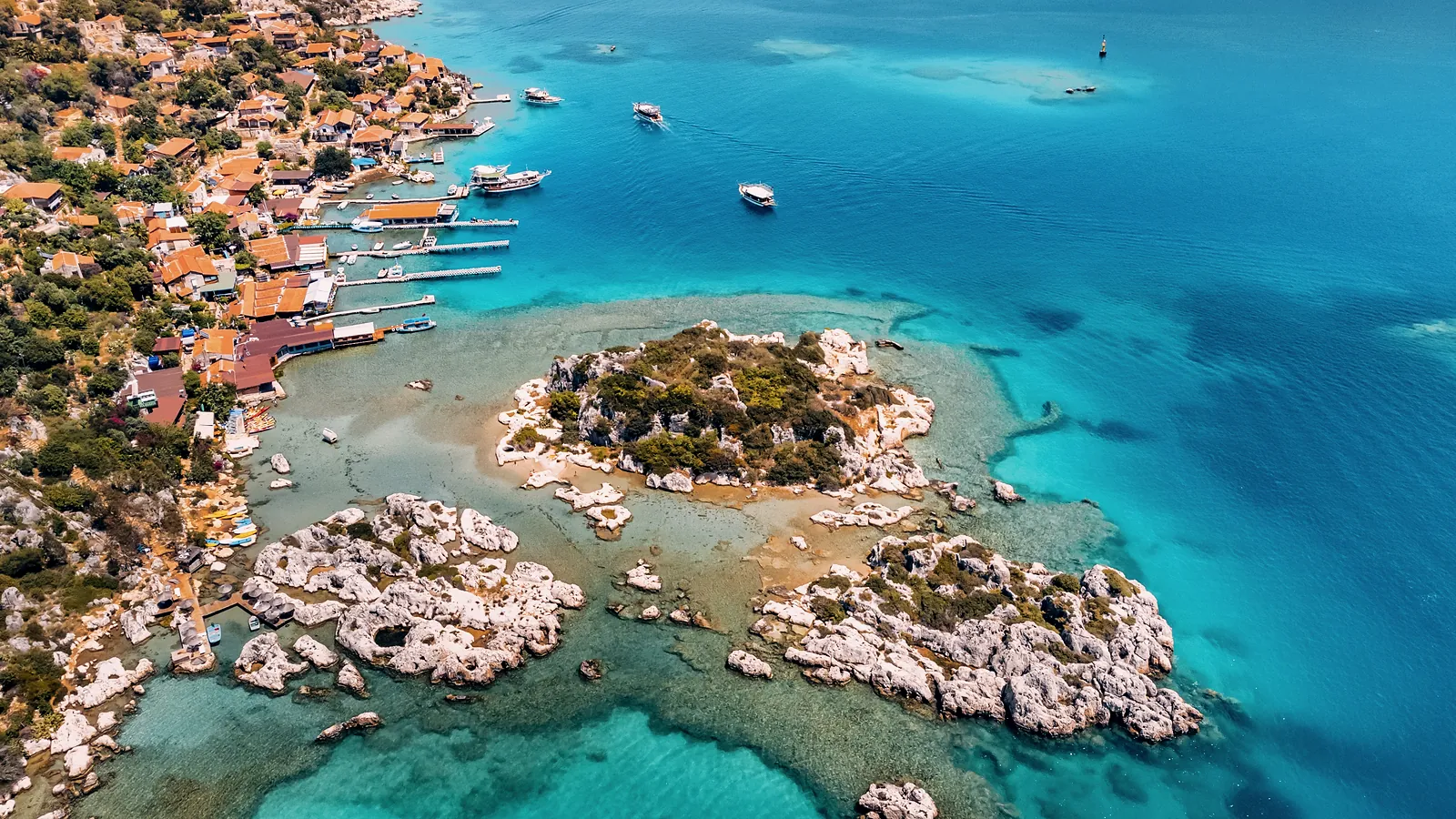
Nothing drives to Simena. The boat ties up under a village of stone pensions, and the way to the castle begins at the water: a steep path of worn limestone, some of its steps ancient. Two Lycian sarcophagi stand beside it. One has a small exedra, a recessed seat. The other carries an inscription dedicated to Mentor, son of Argus.
Mentor is the first person in Simena you can name. The town is harder to pin down. A Lycian inscription and a silver coin found at Aperlai point to the fourth century BC, and the first author to mention it is Pliny, in the first century AD.
One vote for four towns
Simena belonged to a small union headed by Aperlai, with Isinda and Apollonia as the other members. The Lycian League gave its cities votes by size, and the four shared a single one, which Aperlai cast. The sailing directions known as the Stadiasmus Maris Magni list the town as Somena, sixty stadia from Aperlai. It stayed an independent city when the region joined the Roman Empire.
The way up
The climb takes about ten minutes, with no shade. The walls at the top are medieval, Byzantine in origin with later repairs, and the battlements finish in swallowtails. The Byzantines fortified the acropolis against Arab raiders, and some accounts credit the Knights of St John with later work. Inside the circuit are cisterns, rock-cut tombs and a building that began as a temple and ended as a mosque, with a church in between.
Seven rows in the rock
The theatre sits inside the walls, cut straight into the bedrock. It has seven rows of seats and, according to the Ministry of Culture and Tourism, room for 300 people. Some read it as a bouleuterion, a council chamber. Either way it was made for a small public. From the top row the strait opens out, with the long ridge of Kekova island beyond.
A bath for Titus
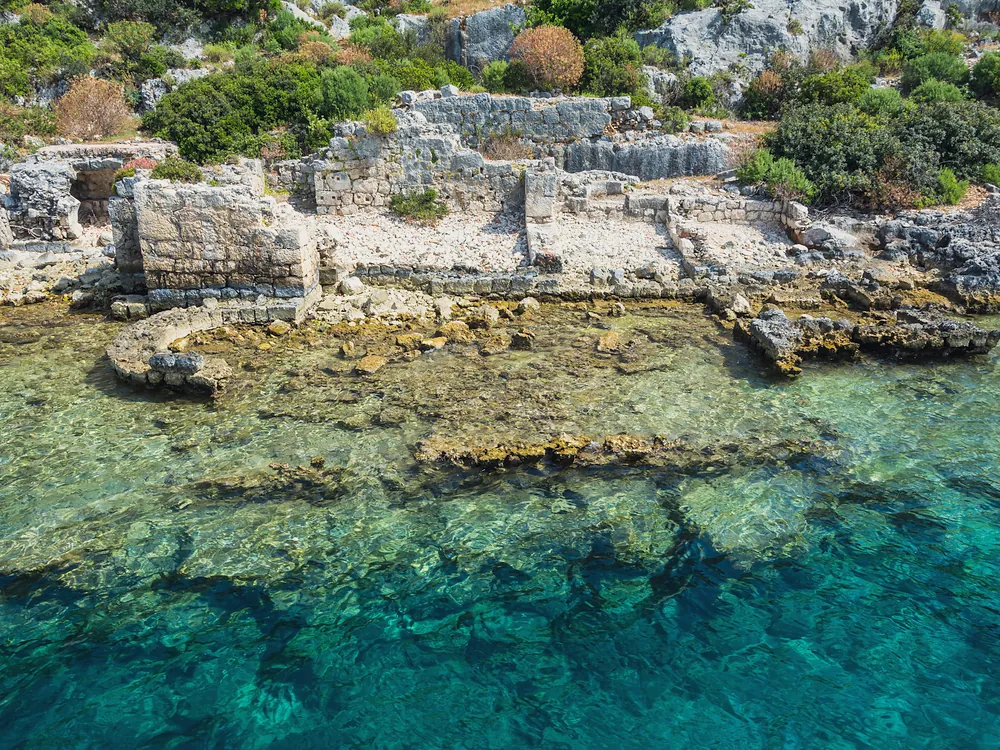
The first ruin you pass at the shore is the Roman bath. Its inscription records that the people and council of Aperlai, with the other cities of the union, dedicated the building to the emperor Titus, who reigned from AD 79 to 81. Four towns with one vote between them gave an emperor a bath, and said so in stone.
A shoreline that dropped
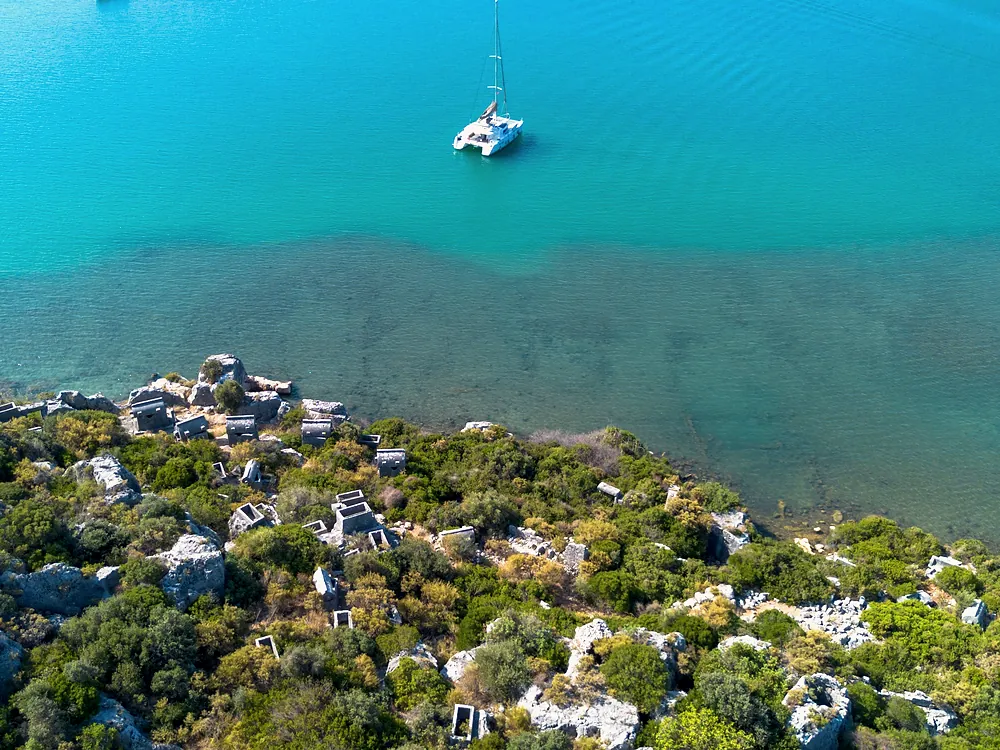
Part of Simena is under the sea. Earthquakes in ancient times, usually dated to the second century AD, lowered this stretch of coast, and in still weather the jetty and building ruins show through the water. Below the village a sarcophagus stands in the shallows, half submerged and leaning. It is the picture everyone takes home. It is also evidence: the tomb was built on dry ground.
Lids like roofs
North-east of the castle a necropolis of sarcophagi and rock tombs covers the slope. The lids are pointed, a shape Lycian builders used because it echoed the timber roofs of their houses, and one house-type tomb carries an inscription in the Lycian language.
Editor's picks
- Read the two sarcophagi on the path.The exedra and Mentor's inscription are beside the steps.
- Sit in the top row of the theatre.Kekova island lies across the strait.
- Walk the walls and look for the swallowtails.The cisterns are inside the circuit.
- Find the Lycian inscription.It is on a house-type tomb in the necropolis.
- Walk in from Üçağız and go home by boat.The path is about 2.2 km, roughly 45 minutes, with the bay in view.
- Add the channel.Dolichiste, the sunken town on the northern shore of Kekova island, lies across the strait, and a boat day from Kaş covers both.
Insider notes
Entry is ticketed, and Simena is on the Müze Kart list. The ticket office closes before the gate, and hours shorten through the year, so check the posted times. The path is slick in places, so wear shoes with grip and bring water.
Swimming, snorkelling and diving over the sunken ruins have been banned since the area became a protected zone in 1990. Boat crews know the limits. The Lycian Way does not enter the village: it passes a junction to the north-east, and a footpath leads in from there past the castle.
Send this to whoever you would go with. WhatsApp
How to get to Simena
Dalaman and Antalya are both about three hours by road from Üçağız. No road reaches Simena itself: boats cross from Üçağız, Kaş and Demre. Üçağız is about 45 minutes from Kaş by road, and a footpath of about 2.2 km links it to the village. Flights from Europe and Istanbul are covered in Getting there.
Beside the path to the castle, a sarcophagus is still dedicated to Mentor, son of Argus.