Active / Diving
Kaş, the Dive Town Where the Reef Starts Half an Hour From the Quay
A cotton freighter, an Italian bomber and a cleft between two islets all lie within reach of the harbour at Kaş. Meis stays in view the whole way out.
The dive boats leave Kaş in the morning with the decks stacked in tanks, and for the first ten minutes nobody looks at the water. They look at Meis, the Greek island of Kastellorizo, lying across the strait with its own small harbour and its own rows of painted houses. Then the engines slow, the skipper lines up a mark on the cliffs behind the town, and the boat is over a reef.
That is the logic of diving here. The sites sit in a short run of water between the Çukurbağ peninsula and the islets towards Meis, most of them within half an hour of the harbour. Visibility often passes thirty metres, so the bottom is readable from the surface.
A freighter in a cleft of rock
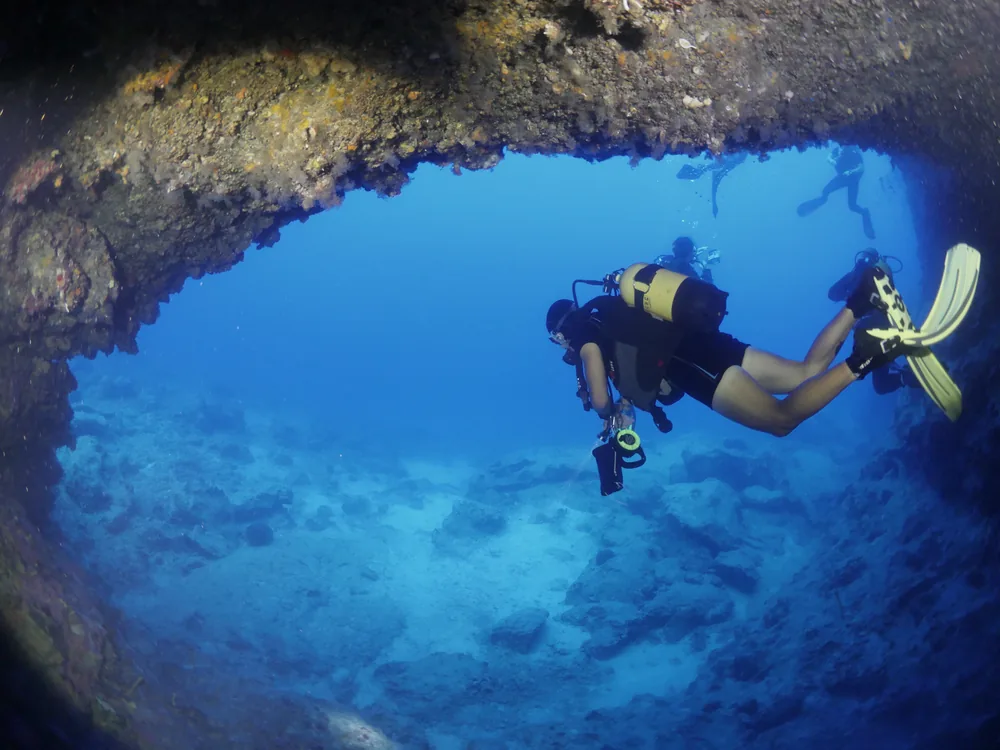
Canyon is the dive people mean when they say Kaş. Two islets stand close together, and the water between them is a narrow cleft, its walls starting near the surface and falling to around twenty metres. You slide through more than you swim. Below the far end lies the Dimitri, a cargo ship loaded with cotton that went onto the rocks in the late 1960s and was later broken up. Its ribs are spread down the slope at depths from the high twenties to the low forties, and a memorial to a Kaş diver is fixed to the wall near thirty metres.
Mind the current. It comes up from the south, and operators keep Canyon for divers who already have some miles in their logbooks.
Just beyond it, the reef called Flying Fish takes its name from an Italian Second World War bomber that rests on the seabed at about sixty-five metres, which puts it with technical divers. Everyone else gets the reef above, a rocky slope where groupers, amberjack and barracuda cruise through the current.
Two wrecks that are not what they seem
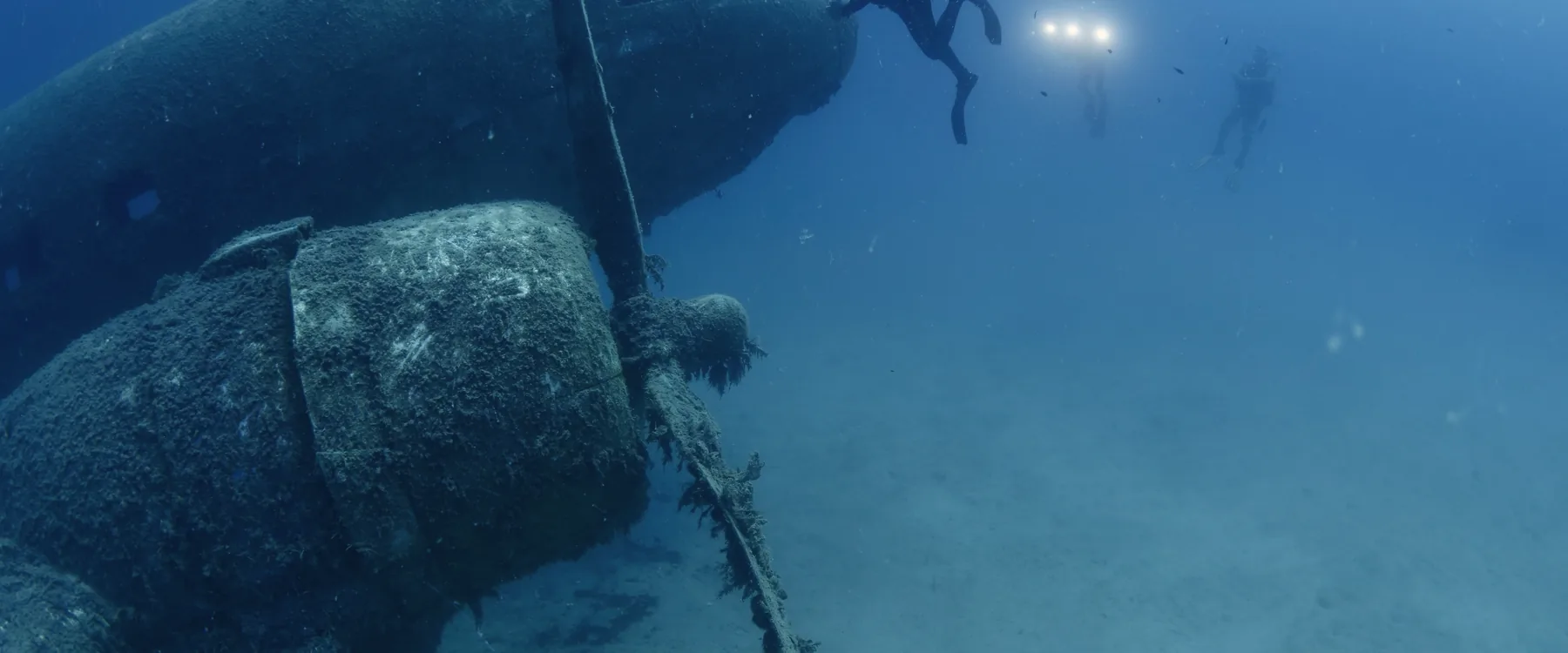
Kaş has a second aircraft, and this one is easy to reach. A Dakota retired from the Turkish Air Force was sunk in the bay at Limanağzı in 2009 as an artificial reef. It sits upright on sand at around twenty metres, the fuselage about twenty metres long and the wings spread wider than that. It is where newer wreck divers learn what a wreck feels like.
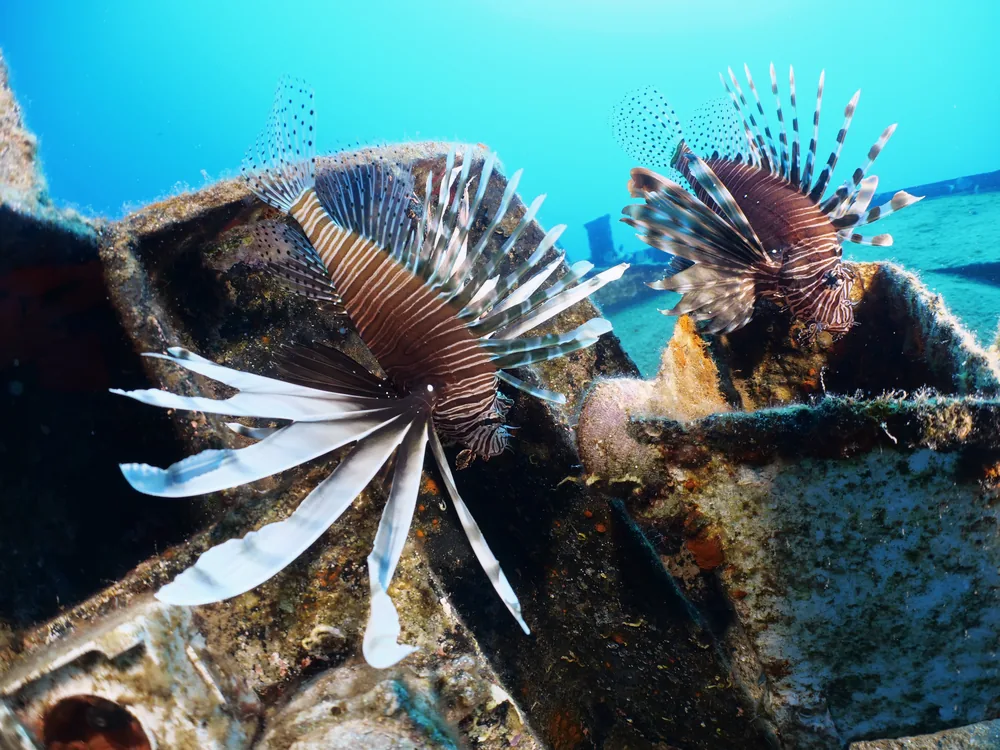
In Hidayet Bay, on the Çukurbağ side of town, the ship on the bottom was never afloat. In 2006 the Underwater Research Society built a full-size replica of the Bronze Age Uluburun trading ship, loaded it with imitation cargo and sank it as a classroom for underwater archaeology. The real wreck lies off a headland southeast of Kaş, far too deep for sport divers. The replica shows how a ship that old settles on the seabed.
Editor's picks
- Start with the Dakota.Shallow, upright and close to town, it is the easiest wreck on the coast to read.
- Give Canyon a second day.A few easier dives first will settle your buoyancy, and the current rewards a steady diver.
- Ask about the Flying Fish reef.The bomber is for technical divers. The big fish are on the reef above it.
- Dive Hidayet Bay.The replica hull teaches more about Bronze Age trade than a glass case would.
- Ask for the amphora sites.Storage jars lie in the rock at Kaş Neptün from about twenty metres down, and the guides know which spots are worth the depth.
- Spend the surface interval in town.Walk the Uzun Çarşı bazaar, then take a table by the harbour, where Meis sits on the horizon.
Insider notes
Wind and surge write the dive list, not the brochure. The Kaş Tunnel, for example, is usually dived only in the morning, before the afternoon chop builds. Ask your centre what is realistic on the day and accept the answer.
There are around twenty dive centres in town, and a few work out of hotel basements. Ask to see the boat and the oxygen kit before you book. Certified divers should bring their card and logbook, and first-timers can take a guided introductory dive in the sheltered bays.
The sunken city at Kekova is closed to scuba. It stays a boat-and-snorkel sight, and the dive sites are all on this side of the coast. Divers are advised to wait 18 to 24 hours before flying, so plan the last dive around your flight home.
The guides will tell you not to touch anything underwater, and they are right.
Send this to whoever you would go with. WhatsApp
How to get to Kaş
Dalaman is the closest airport, about two hours by road along the D400 past Fethiye and Kalkan. The dive boats leave from the harbour, so once you are in town the car can stay parked, and the dolmuş serves the rest of the coast. Flights from Europe and Istanbul are covered in Getting there.
Come back up and Meis is still there, small and white across the water, as if nothing had happened.